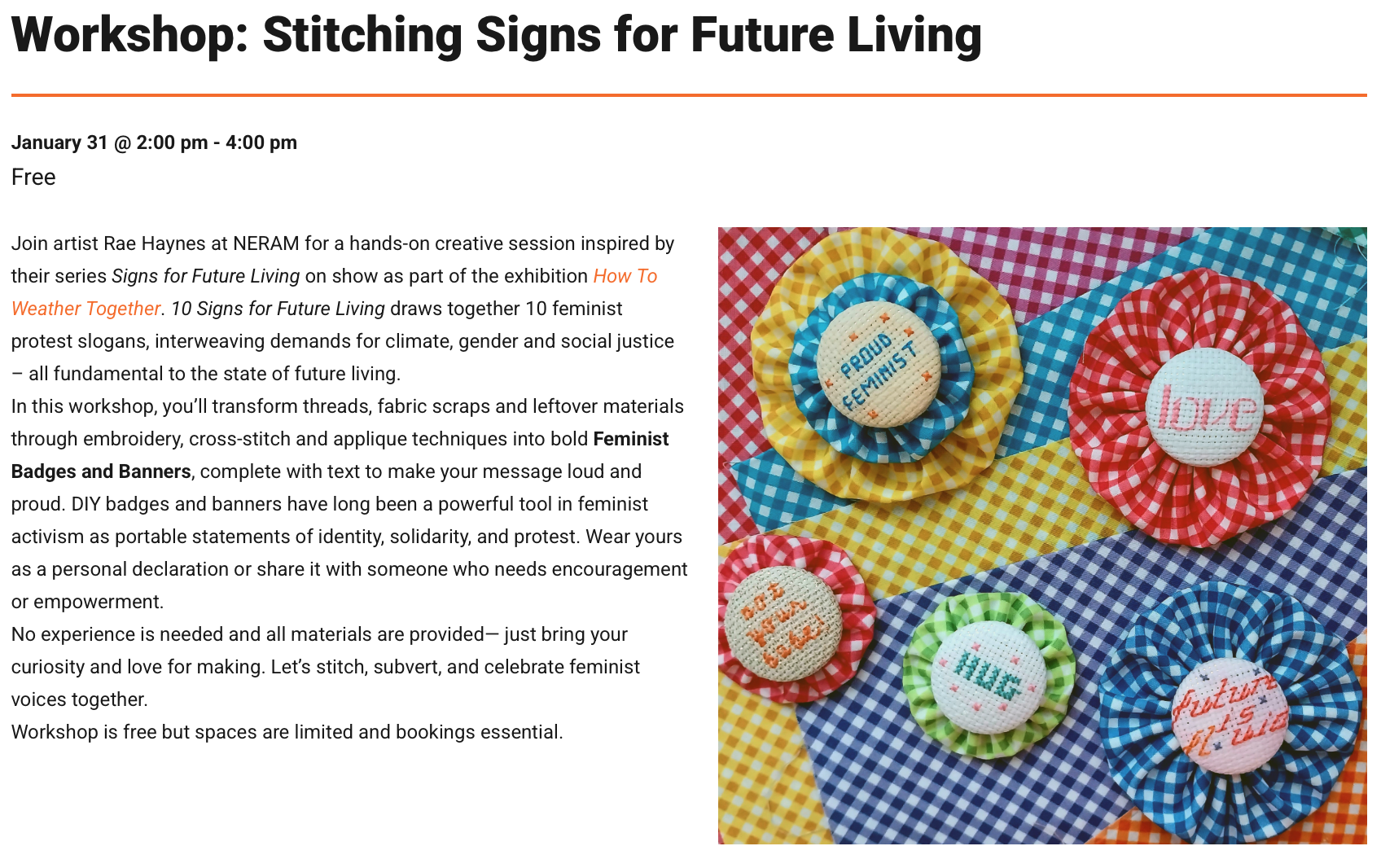
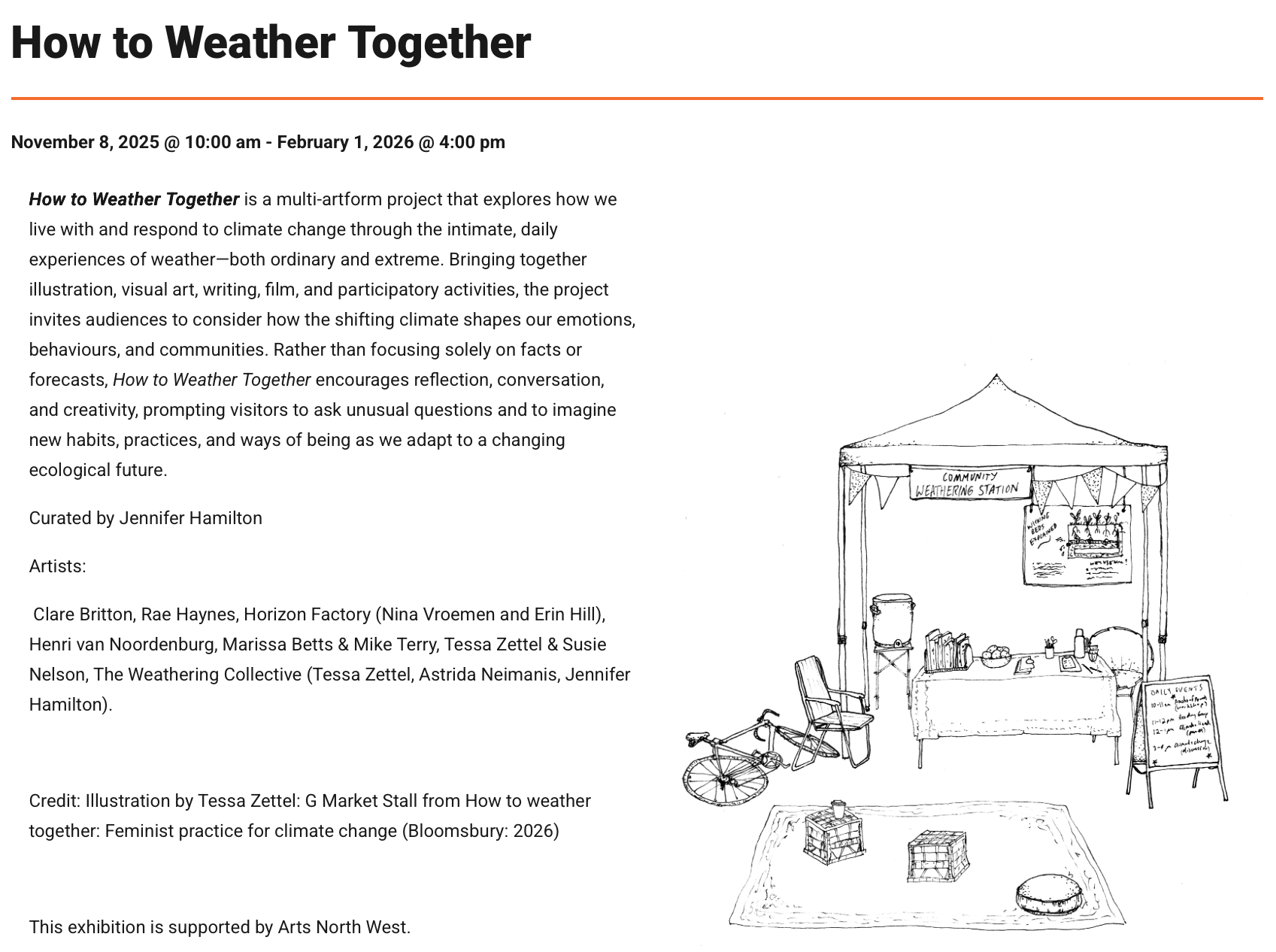
How to Weather Together is a multi-artform project that explores how we live with and respond to climate change through the intimate, daily experiences of weather—both ordinary and extreme. Bringing together illustration, visual art, writing, film, and participatory activities, the project invites audiences to consider how the shifting climate shapes our emotions, behaviours, and communities. Rather than focusing solely on facts or forecasts, How to Weather Together encourages reflection, conversation, and creativity, prompting visitors to ask unusual questions and to imagine new habits, practices, and ways of being as we adapt to a changing ecological future.
CONFERENCE PRESENTATION
‘Subversive Threads: Genderqueer Approaches’
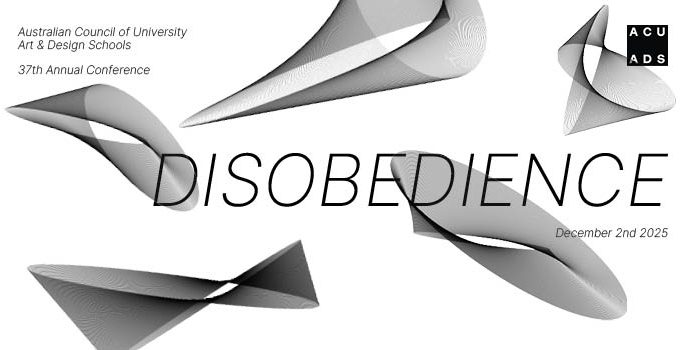
Australian Council of University Art & Design Schools
37th Annual Conference DISOBEDIENCE
2 December, 2025 | UWA, UNSW, Monash Universities
Abstract:
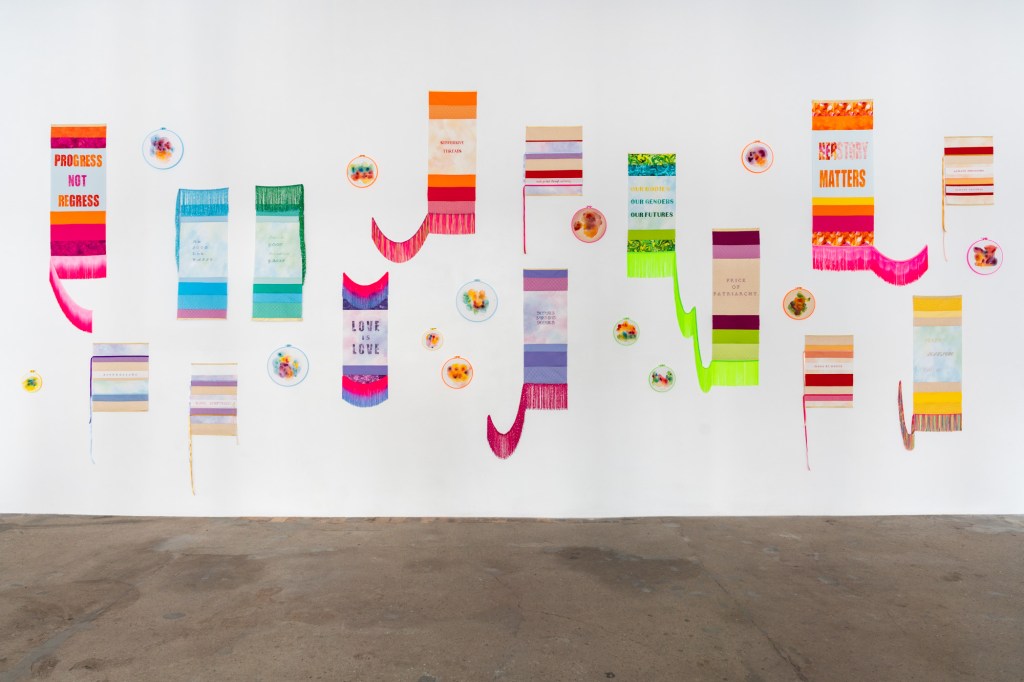
This paper offers a critical reflection on Subversive Threads, a new body of creative research that mobilises textile-based practices as acts of disobedience and genderqueer activism in response to current corrosive politics and cultural uncertainty. Presented in the context of a solo exhibition at Outer Space Contemporary Art, Magadjin and the MELT Festival of Queer Arts and Culture in 2025, the project re-examines embroidery and stitching samplers, appliqué and protest banners — as urgent, resistant gestures for the future. Through genderqueer methodologies of making-as-doing, the work engages with the politics of materiality, language, and gesture to provoke, reveal, and contest cultural values in relation to gender diversity, equity and inclusion.
The title of this project expands on the seminal text by Rozsika Parker, The Subversive Stitch (1984), 40 years after its publication. Subversive Threads reclaims the form of the needlework sampler as a contemporary site of resistance and protest. With its historical associations of obedience, the stitching sampler is ripe for creative acts of disobedience – unpicking, unravelling, undoing. These materialdisruptions of normative gender codes transform ‘sampling’ into an act of both refusal and reclamation. In Subversive Threads disobedience becomes a generative force for reclaiming genderqueer politics and reimagining collective futures.
About the Exhibition:Subversive Threads is a new solo exhibition by artist Rae Haynes, presented at Outer Space. Known for a contemporary feminist practice that interrogates gender ethics and the language of abstraction through text-based works, textiles, and installation, Haynes brings together personal history and political inquiry in this exhibition. The work emerges from Haynes’ research into the legacies of embroidery in feminist art, particularly through the lens of Rozsika Parker’s seminal text The Subversive Stitch (1984). This inquiry led to the discovery of genealogical connections to Mary Linwood (1755–1845), a pioneering British textile artist and educator renowned for her ‘needle painting’ technique and public exhibitions in 19th-century London. Further archival investigation revealed that in the 1890s, Haynes’ ancestors Claudia and Ada Hull established Linwood College in Bulanaming/Marrickville, named in honour of Mary Linwood. Through feminist, genderqueer, and decolonial methodologies, Haynes explores these familial and creative legacies via archival research, auto-theoretical storytelling, and participatory workshops. The project reframes embroidery as both a personal and political tool of resistance.
CONFERENCE POSTER PRESENTATION
RE-EVALUATION IN FEMINISM AND CONTEMPORARY ART
CREATE/FEMINISMS
Middlesex University, UK
13 September, 2024
Organisers: Professor Katy Deepwell and Associate Professor Alexandra Kokoli
About the Conference: this conference aims to re-evaluate feminist research and enquiry as it has developed over the last 50 years in relation to different local/global dynamics or about certain artists or artworks. Feminism(s) aim to interrogate existing histories and provide significant corrections to what constitutes “history”. Is re-evaluation of artists only a question of reputation and recognition; collective action or how they reference issues of social justice? How have feminism(s)’ challenges changed museums’ curatorial practices, critical writing and art history? And how has feminism itself been transformed over time? What remains missing from the stories that we tell today about past and present feminist interventions in contemporary art?
BRINGING TOGETHER D.I.Y AESTHETICS WITH D.I.T (DO-IT-TOGETHER) ETHOS
Patterns for FutureLiving is a DIY space for participatory and collective action, engaging with feminist protest and ecological justice through text and textiles artworks. The exhibition draws inspiration from the works of modernist artist Sonia Delaunay-Terk, who devised a new visual language for the rhythms of daily life by exploring simultaneous colour, pattern, movement and abstraction. Commissioned for the Brisbane Festival, this body of work explores future potentialities of ‘patterns for living’ – one that embraces the interconnectedness of all living things.
Transnational Belonging and Female Agency in the Arts considers belonging as a manifestation of processes of becoming that traverse borders and generate new spaces and forms of difference. In doing so, the book aims to catalyse mutual social relations founded upon responsibility and response-ability to each other.
I am delighted to be selected as a finalist in the 2022 Sunshine Coast Art Prize with my work Climate Targets (Quilt), 2021. This national acquisitive prize is a dynamic visual arts award reflecting outstanding contemporary 2D arts practice in Australia. The 2022 judge is Ellie Buttrose (Curator: QAG|GOMA).
This anthology invites analysis, reflections and speculations on how contemporary artists and creative practitioners engage with, interpret, and enact care in practices which might forge an alternative ethics in the age of neoliberalism.
It brings together contributions from artists, researchers and practitioners who creatively consider how care can be practised in a range of contexts, including environmental ethics, progressive pedagogies, cultures of work, alternative economic models, death literacy advocacy, parenting and mothering, deep listening, mental health, disability and craftivism.
A bold and strikingly illustrated record of women’s art and feminism in Australia.
I’m excited that my work, as well as collaborative work with LEVEL, has been included in the major anthology, Doing Feminism: Women’s Art and Feminist Criticism in Australia by Anne Marsh. Doing Feminism represents over 220 artists and groups with 370 colour illustrations punctuated by extracts from artists’ statements, curatorial writing and critique. Tracking networks of art practice, exhibitions, protest and critical thought over several generations, Marsh demonstrates the innovation and power of women’s art and the ways in which it has influenced and changed the contemporary art landscape in Australia and internationally.
Wallach Art Gallery, Columbia University, New York
Exhibition: 12 June – 14 August 2021
I have been commissioned to produce 3 new works for the exhibition The Protest and The Recuperation. This is a survey of artistic perspectives and responses on the global phenomenon of mass protest, as well as recuperative strategies of resistance. This exhibition presents a focused selection of works that register the power of mass protest from a deeply human perspective. It highlights the individual-to-individual connection in the collective spaces of the mass protest, recovery and care.
I have made 3 new works for the Making Art Work project at the IMA, a large scale textiles banner, a series of fabric collages on paper and a digital textiles poster. These new works continue my exploration of the potential for diverse activist discourses to inform radical frameworks for the future. Drawing on intergenerational and intersectional feminist ideas and practices, the works consider an ethics of care implied by activism for change. These works interweave the political philosophy of Hannah Arendt with feminist protest language.
My new work Let’s take back our space (2020) will be on view at Hutton Lane, Brisbane from August – November. A new digital commission Together (2020) will be projected at Howard Smith Wharves, Brisbane until 20 September, and then on show at The Museum of Brisbane.
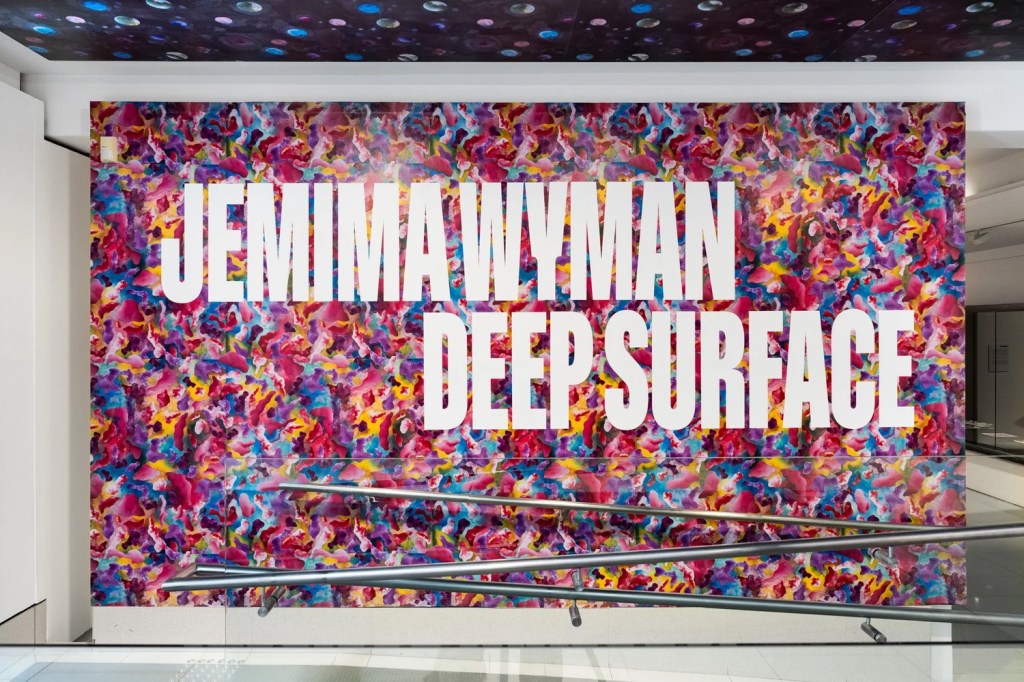
Artists in the project include: Richard Bell, Eric Bridgeman, Gerwyn Davies, Chantal Fraser, Hannah Gartside, Rachael Haynes, Natalya Hughes, Luke Roberts, Sancintya Mohini Simpson, Justin Shoulder & Bhenji Ra and Jemima Wyman.
RAZZLE DAZZLE considers the nature of public space and individuals within it – particularly people who for different reasons, may feel hyper-visible or invisible. Considering ideas of identity, spectacle, and camouflage, the artists included use patterning, colour, or adornment to either hide, exaggerate or transform.
While artist-in-residence at Hope Street in February, I have been making new works that address the polyvocal nature of contemporary feminism in the ongoing Project for the Affirmation of the Voice. Taking as a starting point the provocation that ‘small acts of resistance can create change’, these text-based works draw specifically on contemporary protest language and feminist social history archives. This project addresses both the nature of collective voice in activism and the differences inherent in any understanding of contemporary intersectional feminism.
Open Studio Events:
Join me at the studio in Hope Street for Art Feminism Friday on 21 February 2 – 4pm. Bring along a print-out of a feminist news or magazine article, essay or book chapter, for some Friday afternoon conversation and cut-up collage making.
The PROAV Studio Remix is an evolving exhibition that brings together new and existing fabric works and drawings. The exhibition will be open for viewing on Saturday 29 February 2 – 4pm.
This special edition, Feminism Back By Popular Demand was commissioned by the Museum of Brisbane to coincide with the major exhibition New Woman and is available from the MOB Shop.
This series of creative workshops draws together multiple voices in contemporary feminism and celebrates our differences. Poetry & Protest also considers how to address the pressing concerns of equal rights and social justice today.
Join artist Rachael Haynes and poet Sarah Holland Batt to explore connections between poetry and protest. Through conversation and inspiration, participants will co-create a large-scale collective banner, incorporating fabric techniques and playing with pattern and colour.
New intersections discussion – MOB
New Intersections
Panel Discussion facilitated by Rachael Haynes
With: James Barth, Naomi Blacklock & Courtney Coombs
Museum of Brisbane, Brisbane City Hall
Friday 9 November, 2019
I will be facilitating a conversation with artists James Barth, Naomi Blacklock, and Courtney Coombs in conjunction with the New Woman exhibition at the Museum of Brisbane on Friday 9 November, 2019.
This discussion will explore the ways in which intersectional feminism enables a re-examination of identity in the 21st century. The artists will unpack current ideas of identity in relation to their art practice, and discuss personal intersections of gender, sexuality, and cultural identity. Drawing from diverse lived experiences and arts practices, this conversation will explore fertile connections and new directions for understanding identity in the contemporary world.
I will be presenting current work and research at the CARE: Art, Ethics and Feminism symposium and exhibition in Melbourne from 30th October – 2nd November 2019. The symposium happens over four days with talks, performances, workshops, and artworks, from over 50 artists, activists, writers, researchers, dancers and performers from around Australia who are thinking and practicing care.
I will be presenting Threads of Resistance, including a dedicated maker space and text-textiles workshops, at the Museum of Brisbane. This installation engages with the polyvocal nature of contemporary feminism and takes as its starting point the provocation that ‘small acts of resistance can create change’. Exploring text and abstraction across drawings, textiles works and interactive workshops, this current body of work draws specifically on contemporary protest language and feminist social history archives.
In this interdisciplinary collection, scholars reflect on how contemporary feminism has shaped their thinking and their field as they interrogate its uses, limits, and reinventions. Organized as a set of questions over definition, everyday life, critical intervention, and political activism, the Handbook takes on a broad set of issues and points of view to consider what feminism is today and what current forces shape its future development.